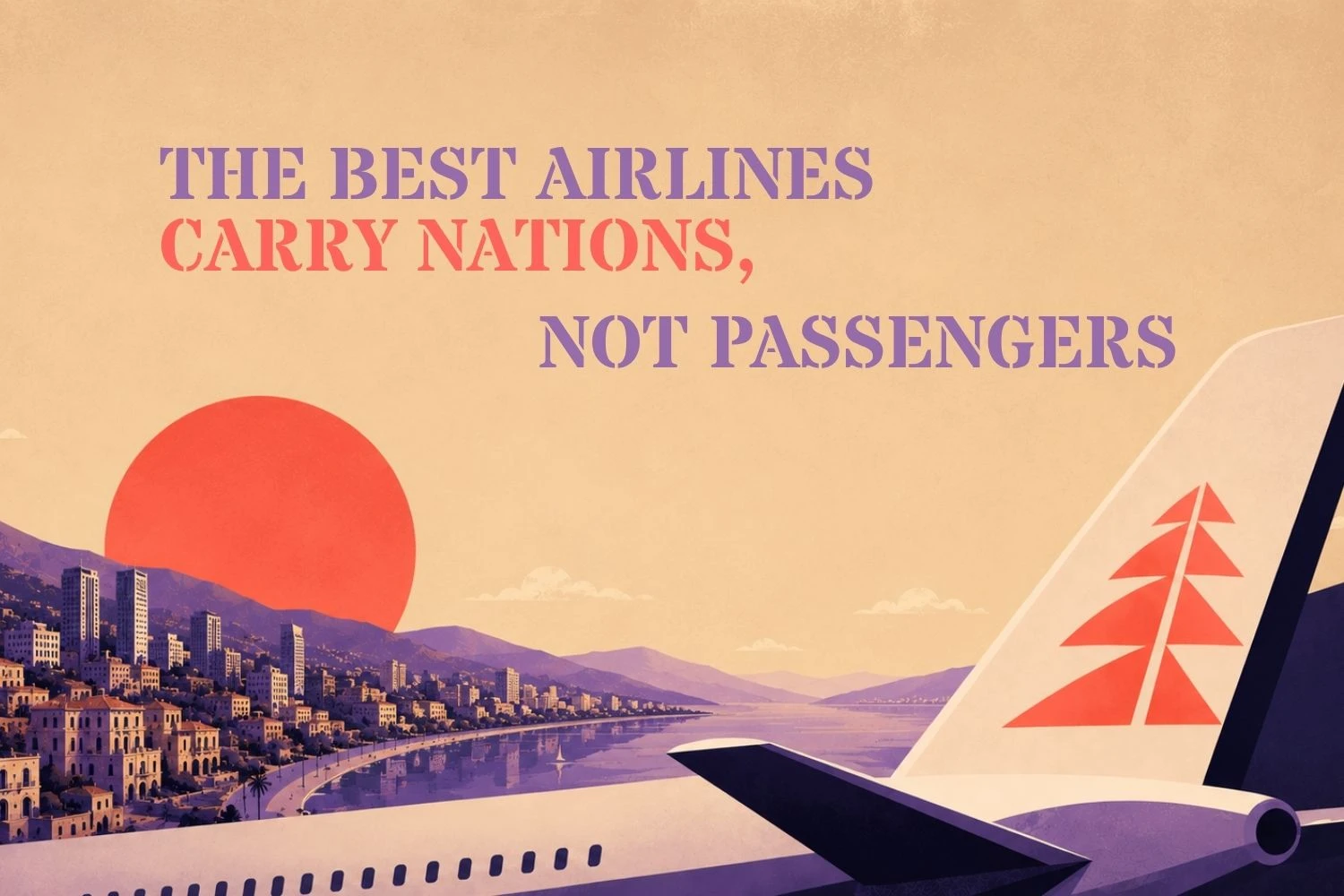
The Best Airlines Carry Nations, Not Passengers
Fly Beirut is taking off. So could the nation’s next benchmark.

It may be difficult to believe, given that the Middle East is continuing to navigate an active conflict that has rattled airspace and rerouted flights across the region, but the aviation boom hasn't stopped. New carriers are being announced, fleets ordered, and air connectivity treated as a pillar of national economic strategy. One of them is Fly Beirut, Lebanon's newly announced low-cost airline.
However, before its first aircraft enters service, it faces a decision that could define it for decades.
Is it building an airline, or is it building a brand?
And those are not the same thing. One lasts far longer than the other.

We’ve already seen what happens when airlines make that decision well. Emirates, Qatar Airways and Etihad, often referred to as the ME3, didn’t earn their global standing through geography alone. They understood that an airline isn’t simply a transportation product. It’s an experience.
Emirates’ brand value reached $10.6 billion in 2026, growing 27% year on year to become the world’s most valuable airline brand outside North America. Qatar Airways claimed the Skytrax World’s Best Airline award for an unprecedented ninth consecutive time in 2025. Those aren’t just marketing successes. They’re the commercial returns of decades of deliberate brand building.

What’s less discussed is what those brands did for their nations. Emirates helped define Dubai as a global crossroads. Qatar Airways repositioned Doha on the world stage long before the 2022 World Cup completed the story. As Paul Clifford observed in Communicate magazine, the line between nation-building and brand-building across the GCC has blurred to the point where destination marketing functions less as communications and more as policy. Saudi Arabia understood that too. As the Kingdom rewrote its global narrative, Riyadh Air arrived not as a coincidence, but as part of the architecture of that story.
That investment paid off again in 2026. The instability triggered by the US-Iran conflict disrupted routes and schedules across the region. Yet the strongest airline brands retained their audiences because they’d built something a geopolitical crisis can’t easily erase: brand trust.
Branding doesn't belong exclusively to premium airlines. Experience has become one of the industry's most powerful competitive advantages. JetBlue proved years ago that customers would willingly pay a premium for an airline that felt human rather than transactional. It transformed Terminal 5 at JFK into a cultural destination through its Live from T5 concert series, built aircraft liveries that celebrated cities and communities, and invested in engaging brand partnerships. Virgin America infused every touchpoint with the bold personality of the Virgin brand, while Air New Zealand turned Māori culture into one of the most distinctive airline experiences in the world and laid the groundwork for what the future of airline safety videos would become.
They all understood the same thing, that brand isn’t decoration. It’s part of the product.
Today, Riyadh Air is proving this region can do the same before a single passenger has even boarded. Before a single flight departed or a single Riyal was generated, the airline commissioned a sonic identity, recorded at Abbey Road Studios by Sonicbrand, one of Brand Lounge’s global sonic branding partners, blending Saudi and international musical traditions into what it called the Sound of a New Era. Saudi designer Mohammed Ashi was appointed to create the cabin crew collection, unveiled during Haute Couture Week, while the airline collaborated with the Ministry of Culture and Tourism to develop an experience rooted in Saudi culture and unmistakably future-facing.
As CEO Tony Douglas put it, “We want to bring glamour, we want to bring refinement, we want to bring grace back.”
Every decision reinforces the same cultural narrative. That’s what it looks like when a brand is built to mean something, not simply to function.
Which brings us back to Fly Beirut.
On paper, it’s a budget airline. In reality, it may have one of the richest emotional brand opportunities in regional aviation.
The Lebanese government estimates there are 15.4 million people of Lebanese origin spread across 96 countries, nearly three times the population living inside Lebanon itself. The World Bank reports the diaspora sent $5.8 billion back to Lebanon in 2024, almost 18% of GDP. These are people who’ve watched Lebanon endure financial collapse, a devastating port explosion and armed conflict, yet still send money home, still return every summer and still carry Lebanon as an active part of their identity.
That’s not a demographic.
It’s a constituency waiting for an airline that understands what the journey home actually means.
Lebanon itself is beginning to turn a corner. The World Bank confirmed the country's economy grew by 3.5% in 2025, its first sustained growth after years of contraction. A new airport in the north is under development, a second terminal at Rafic Hariri International Airport is planned, and in a development that would have seemed unthinkable just a year ago, the United States announced that American carriers will be permitted to fly directly to Lebanon for the first time since 1985. The doors to one of the world's largest and most affluent diaspora markets are opening. At the same time, Lebanon continues to export culture far beyond its borders, from its globally recognised cuisine to fashion houses like Elie Saab and Zuhair Murad, and a creative diaspora that has shaped design, music and media around the world.

Lebanon has never lacked brand equity. What it’s lacked is a platform to activate it.
Middle East Airlines (MEA), Fly Beirut’s parent company, was founded in 1945 and was once regarded as the pre-eminent Arab airline of the golden age of aviation. It has since become defined by its remarkable resilience. But decades without meaningful domestic competition also meant there was little pressure to fundamentally rethink the brand. Fly Beirut enters the market with a rare advantage: it isn’t under any obligation to inherit that posture. It launches with something every strategist hopes for: a blank page.
.webp)
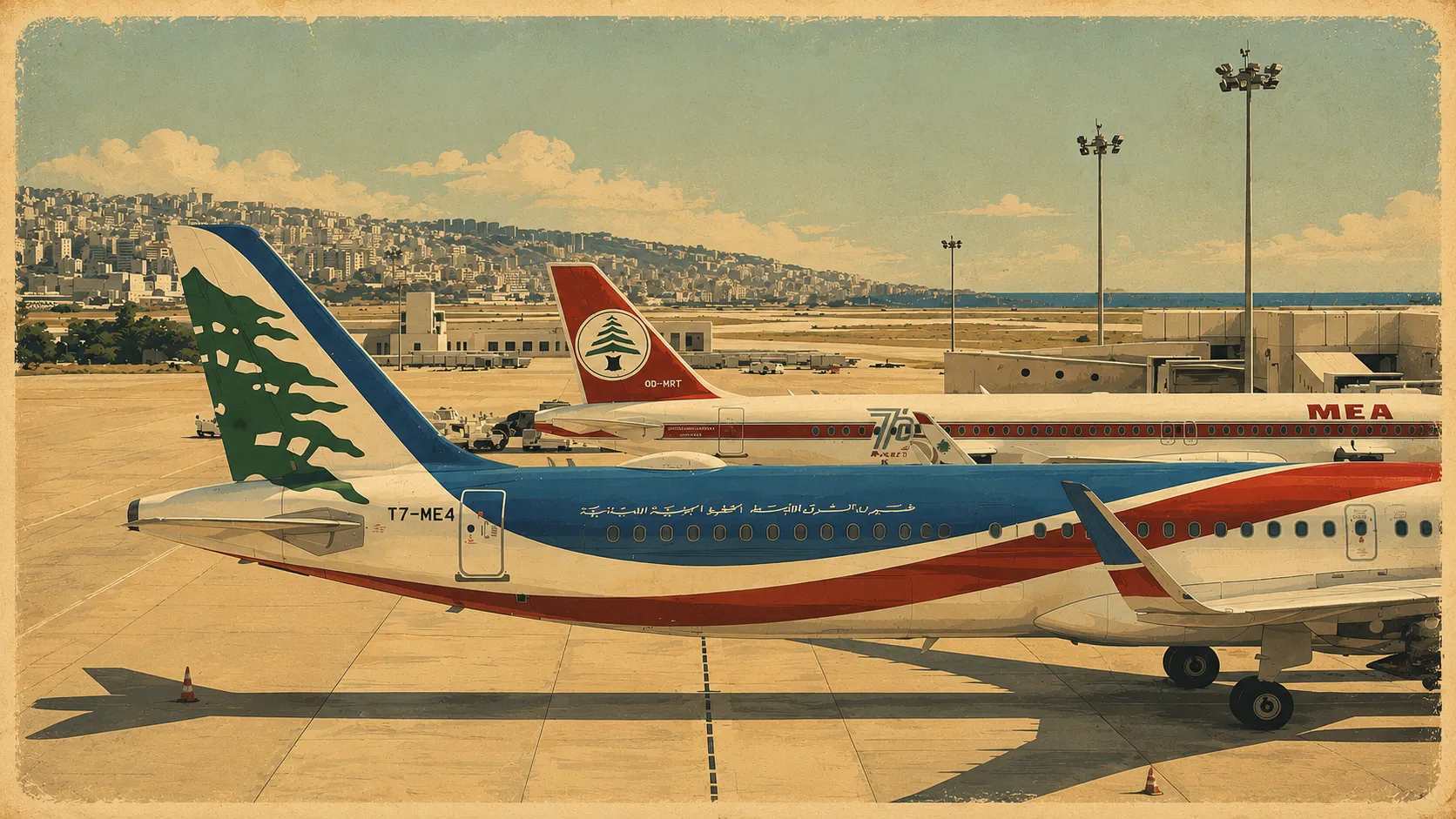
The opportunity is enormous. Fly Beirut could become far more than another low-cost carrier. It could become the region’s most distinctive experiential airline, one that makes Lebanese creative talent fundamental to how it’s built. Designers, musicians, architects, chefs, artists and storytellers from Lebanon and across its diaspora shaping what the experience looks, sounds and feels like.
Done with intention, Fly Beirut wouldn’t simply serve routes.
It would serve identity.
It would become a cultural statement at 35,000 feet.
In a country rebuilding its international perception, that’s not a branding exercise.
It’s nation-building by another means.
There’s a longer game, too. Brand equity doesn’t stay where it’s built. It flows upstream. A subsidiary that earns genuine loyalty will inevitably reshape how the world sees its parent, and eventually MEA may find itself asking a question it has never really needed to answer before: is our own brand keeping pace with what we’ve built beneath it?
As branding strategist Isabel Tapp puts it, “Perception is the ultimate soft currency that converts into hard economic data.”
For a country relying on tourism, investment and diaspora confidence to support its recovery, that’s not a metaphor.
It’s the balance sheet.
For any new airline, I believe there are three decisions that should be made before the first flight.
- Write the brand brief before the fleet brief. Aircraft are replaced every twenty years. A brand built with purpose compounds for generations.
- Start with the emotional truth, not the functional product. For Fly Beirut, that means answering one question before anything else: What does it mean to fly home?
- Appoint a brand guardian before appointing an advertising agency. Someone whose job is ensuring every touchpoint tells the same story, consistently, at every altitude.
The window for a founding brand decision is surprisingly narrow. It exists while the brief is still being written, before aircraft are painted and campaigns are launched. The airlines that defined this region understood that early.
Every great airline eventually becomes known for something beyond the destinations it serves. Emirates became a symbol of ambition. Qatar Airways became synonymous with excellence. Riyadh Air is setting out to express a new Saudi Arabia.
Fly Beirut has the chance to become something different.
Not the airline that takes Lebanese people home. The airline that understands what home feels like. The question isn’t whether Fly Beirut can afford to invest in its brand.
It’s whether Lebanon can afford for it not to.

Latest News & Insights
.webp)

.webp)
.png)
.webp)
Our Practices
Through strategy, design, culture, and innovation, our practices are built to create brands with meaning.