How to Write a Branding RFP That Gets You a Brand That Actually Means Something
A Practical Guide for Marketing Managers and CMOs Who Are Serious About Doing This Properly.
In this article:
01. Why Most Branding RFPs Fail Before They're Sent
02. Agency, Consultancy, or Design Studio — Who Should You Be Briefing?
03. What Does a Strategic Branding Process Actually Look Like?
04. Strategy Is Not a Phase You Can Compress
05. Should You Be Realistic About Timelines and Budget?
06. Who Are the Decision Makers on Your Side?
07. What Deliverables Should You Actually Be Asking For?
08. Does the Brand End at Guidelines?
09. Should You Ask Agencies to Pitch Creative Ideas for Free?
10. What a Strong RFP Actually Contains

01 /
Why Most Branding RFPs Fail Before They're Sent
Most branding RFPs are written backwards. They open with a list of deliverables and close with a deadline that is already too tight. They describe outputs without ever naming the problem. Then they go out to five agencies simultaneously, produce five presentations of wildly varying quality, and the client ends up choosing based on aesthetics rather than thinking.
This isn't a procurement failure. It's a brief failure.
The document you send before anyone is in the room is the first strategic decision you'll make about your brand. It signals what you value, how clearly you've thought about the challenge, and whether you're genuinely ready to do the work. A shallow brief attracts shallow responses. A brief that names the real problem attracts the kind of thinking that changes something.
This guide is written for organizations that want to approach a branding exercise seriously. It won't tell you what font to ask for. It will help you think through what you actually need, who you need it from, and how to create the conditions for genuinely good work to happen.
02 /
Agency, Consultancy, or Design Studio...
Who Should You Be Briefing?
Before you write a single line of the RFP, you need to answer a more fundamental question: who is this actually going to?
There is a meaningful difference between a brand consultancy, a creative agency, and a design studio. Sending the same brief to all three is one of the most common mistakes organizations make. You'll receive responses that are impossible to compare, because the three types of partners are offering fundamentally different things.
A design studio will give you craft. Strong visual thinking, a distinctive aesthetic point of view, and the ability to translate a brief into something that looks and feels considered. What many design studios won't offer is deep strategic development. If the strategy arrives underdeveloped, the visual work, however beautiful, will be built on an uncertain foundation.
A creative agency will typically offer both strategy and creative execution, but the relationship is often more transactional. Agencies are good at delivering work at scale and to deadline. For organizations that need a full-service partner across multiple channels and campaigns, that model works well. For a foundational branding exercise that requires genuine organizational introspection and senior strategic input, the transactional nature of the agency relationship can work against you.
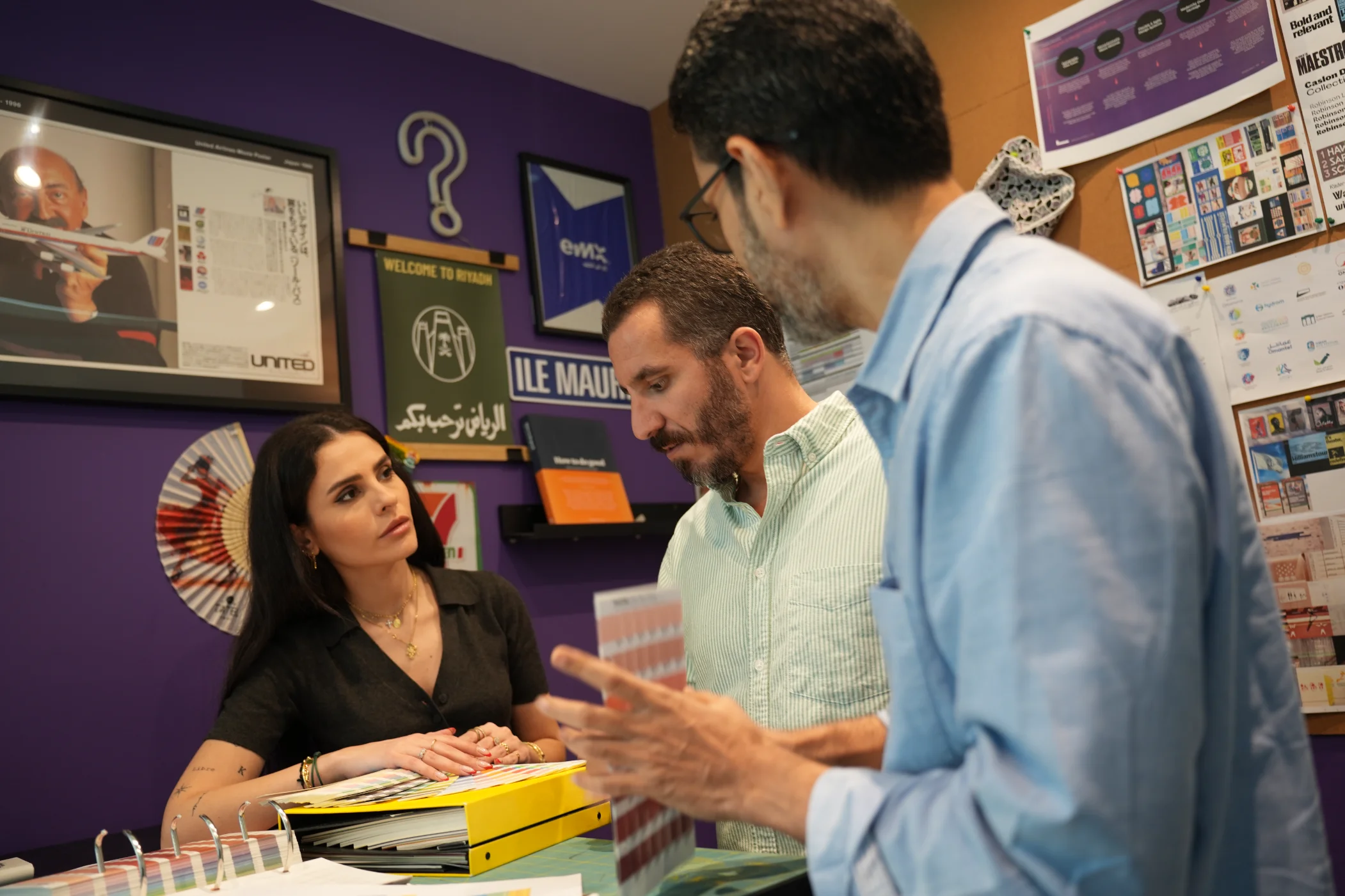
A brand consultancy operates differently. The work is more collaborative, the engagement more intensive, and the focus is on getting the strategic foundation right before anything visual is touched. A good consultancy will involve your leadership, challenge your assumptions, and work alongside you rather than presenting to you. The relationship is built on proximity and shared accountability rather than deliverable handoffs. At Brand Lounge, we've found that the projects that produce the most meaningful results are almost always the ones where the client came to us as a genuine partner, not as a vendor to manage.
For heavy branding exercises, the kind that require genuine strategic thinking, stakeholder alignment, and a brand built to hold up over years rather than months, a consultancy partner is almost always the right choice. The brief you write will reflect that decision. It will ask different questions and attract different responses.
.webp)
03 /
What Does a Strategic Branding Process Actually Look Like?
Understanding how a serious branding exercise is structured will make you a significantly better client. It will also help you evaluate which partners are genuinely equipped for the work.
At Brand Lounge, we work through four phases: Discover, Uncover, Differentiate, and Maximize. We share this not as a sales proposition but because the logic behind it reflects what any serious branding process requires, regardless of who is doing the work.
Discover is the internal audit. Before any external thinking begins, the brand needs to be understood from the inside. What does it actually stand for today, not in the brand book but in the experience customers have and the stories employees tell? Where are the gaps between what the organization intends and what the market perceives? What has changed, competitively, culturally, organizationally, that has made this the right moment for a rebrand?
The clients who arrive at this phase having already asked these questions produce better work. Not because they have all the answers, but because they understand the nature of the question. A strong RFP reflects this clarity. It names the gap honestly and invites the agency to help close it.
Uncover is the most collaborative phase. This is where the real strategic work happens: stakeholder alignment, competitive benchmarking, and the kind of structured conversation that gets leadership in the same room to agree on what the brand stands for before any creative direction is set. At Brand Lounge, we run a Point of Differentiation workshop at this stage. It's designed to surface what the organization can genuinely and credibly own in the market, not what it aspires to be, but what it is uniquely positioned to claim.
Differentiate is where that strategic foundation becomes something tangible and where, in our experience, brands that matter are born. Purpose and positioning are translated into visual and verbal identity, a brand that looks, sounds, and behaves in a way that reflects everything that came before it. This is where the strategic thinking stops being a document and starts being something a customer can feel.
McKinsey's research on the business value of design found that companies with stronger design performance consistently outpaced industry peers on revenue growth and total returns to shareholders, reinforcing why this phase deserves the same rigor as any financial or operational decision. (McKinsey & Company)
Maximize is the phase most branding exercises never reach, and it's often where the real difference between a brand refresh and a brand transformation is made. This is where Creative Impact comes in: the activation of the brand across every touchpoint, from launch strategy and internal induction to digital experiences, campaign assets, environmental design, and the cultural alignment that makes the brand real for the people who deliver it every day.
When writing your RFP, ask prospective partners to walk you through their process. The answer will tell you a great deal about how seriously they take the work beyond the guidelines.
.webp)
04 /
Strategy Is Not a Phase You Can Compress
There is a version of a branding exercise where strategy is a two-week sprint that produces a document nobody fully believes in, followed by six weeks of visual development. That process exists. It produces work that looks fine and means very little.
The organizations that end up with brands that genuinely hold up, that create real recognition, real preference, and real internal alignment, are the ones that give the strategic phases the time they require. Stakeholder alignment takes longer than anyone expects, particularly in organizations where leadership has different views on what the brand is for. Competitive benchmarking done properly surfaces insight that changes the brief. The positioning work requires iteration. The first answer is rarely the right one. That's not a problem with the process. That is the process.
A strong RFP acknowledges this. It doesn't set a timeline that compresses strategy into a formality. It asks agencies to propose a phased plan that reflects the actual complexity of the work, and it treats the strategic phases as deliverables in their own right, not as preamble to the logo presentation. This is what distinguishes long-term brand building from short-term activation, and why durable brand effects need sustained investment over time. (Warc)
05 /
Should You Be Realistic About Timelines and Budget?
Yes. Both. And they're connected.
On time: a serious rebranding exercise, one that covers strategy, identity, guidelines, and activation, takes a minimum of six months. Often longer. Any partner that tells you otherwise is either describing a much smaller scope than you think you're getting, or moving faster than the work can sustain. Compressed timelines produce compressed thinking. A brand built on compressed thinking will need revisiting far sooner than one built properly.
On budget: great brand work costs what it costs because of the expertise, time, and senior attention it requires. Expecting a transformative strategic and creative exercise for a minimal investment is not a negotiating position. It's a brief to the wrong partner. The organizations that get the best work are honest about what they can invest and find a partner whose capabilities match that reality. This matters even more in a market where CMOs still report insufficient budget to execute their strategy. (Gartner)
Include a budget range in your RFP. Not a precise number, but a range that reflects genuine intent. Agencies and consultancies use that information to scope properly and tell you what's achievable. An RFP without a budget range produces proposals that are either wildly over-scoped or frustratingly vague. Neither serves you. Transparency at this stage is a sign of organizational maturity, and the right partners will respond to it with the same clarity.
06 /
Who Are the Decision Makers on Your Side?
This is a question most RFPs don't ask. It's one of the most important ones.
Branding exercises stall, drag, and occasionally collapse not because the creative work is wrong but because the decision-making structure on the client side was never clarified. Work gets approved at one level and reversed at another. Stakeholders who weren't in the room in month one arrive in month four with strong opinions. The brief evolves in ways nobody agreed to. The agency is left navigating internal politics that have nothing to do with the brand.
A well-written RFP names the decision-making structure clearly. Who is the primary point of contact? Who has final sign-off on strategy? Who has final sign-off on creative? Are those the same person? If not, how are conflicting views resolved? Is there a steering committee, and if so, who sits on it?
The right partner will want to know this before they begin. It's not a bureaucratic question. It's a question about whether the conditions exist for good work to actually get made. The key decision makers should be in the room from day one, not receiving summaries after the fact, but present, engaged, and empowered to make calls. We've seen firsthand what happens when that isn't the case. The bottlenecks that emerge mid-project are almost always traceable to a governance structure that was never established at the start. It doesn't matter whether you're a startup, a government entity, or a large corporation. Get the right people in the room from day one.
07 /
What Deliverables Should You Actually Be Asking For?
Once the strategic foundation is in place, the Differentiate phase is where it becomes something real. Visual identity, tone of voice, and brand expression are developed not as decoration over a strategy document, but as its direct translation.
The fundamentals are what most RFPs already cover: brand strategy, visual identity system, logo, color, typography, photography direction, and brand guidelines. These are the foundation. Ask for them clearly and expect them to be grounded in strategic rationale, not presented as aesthetic choices.
Then push further. Think about where the brand actually needs to show up. A website that reflects the new brand rather than just updating the logo. Photography and video assets that give the brand visual currency across every channel. Social media and communications templates. Packaging if relevant. Environmental and wayfinding design if the brand has a physical presence. Presentation templates your team will actually use.
The deliverables you ask for in the RFP signal the scope of your ambition. An RFP that stops at guidelines is already planning for the brand to live in a folder. True growth depends on aligning brand experience, customer experience, and employee experience, which is why brand deliverables need to extend beyond identity assets alone. (Forrester)
08 /
Does the Brand End at Guidelines?
It doesn't. And this is the section most branding briefs are missing entirely.
Brand guidelines are a reference document. They describe how the brand should behave once it exists. They are not a launch strategy, an internal alignment program, or a plan for how the brand will actually enter the world. Most branding exercises end the moment guidelines are handed over, and what follows is a quiet fizzle rather than the transformation the organization had in mind.
The brand needs to go internal before it goes external. The people who deliver the brand experience every day, in sales conversations, in customer service calls, in the way they introduce the company at a conference, need to understand the new purpose and believe in it before a single external asset goes live. Internal induction and employee onboarding are not communication exercises. They are the first act of brand activation. Culture is the first audience. If that audience isn't brought along properly, no external campaign will compensate. Harvard Business Review makes this point directly: purpose only becomes useful when it creates internal alignment, collaboration, and behavior inside the organization. (Harvard Business Review)
Beyond the internal launch, think about everything the brand needs to do in the world. Tone of voice and key messaging that gives the organization a consistent way to speak. A digital presence that reflects the new brand with conviction. Photography and video that creates visual equity across every touchpoint. Sonic branding for brands that live in audio environments. Wayfinding and environmental design for brands with physical spaces. Event and exhibition design. Campaign-ready assets. These are not afterthoughts. They are the brand in action.
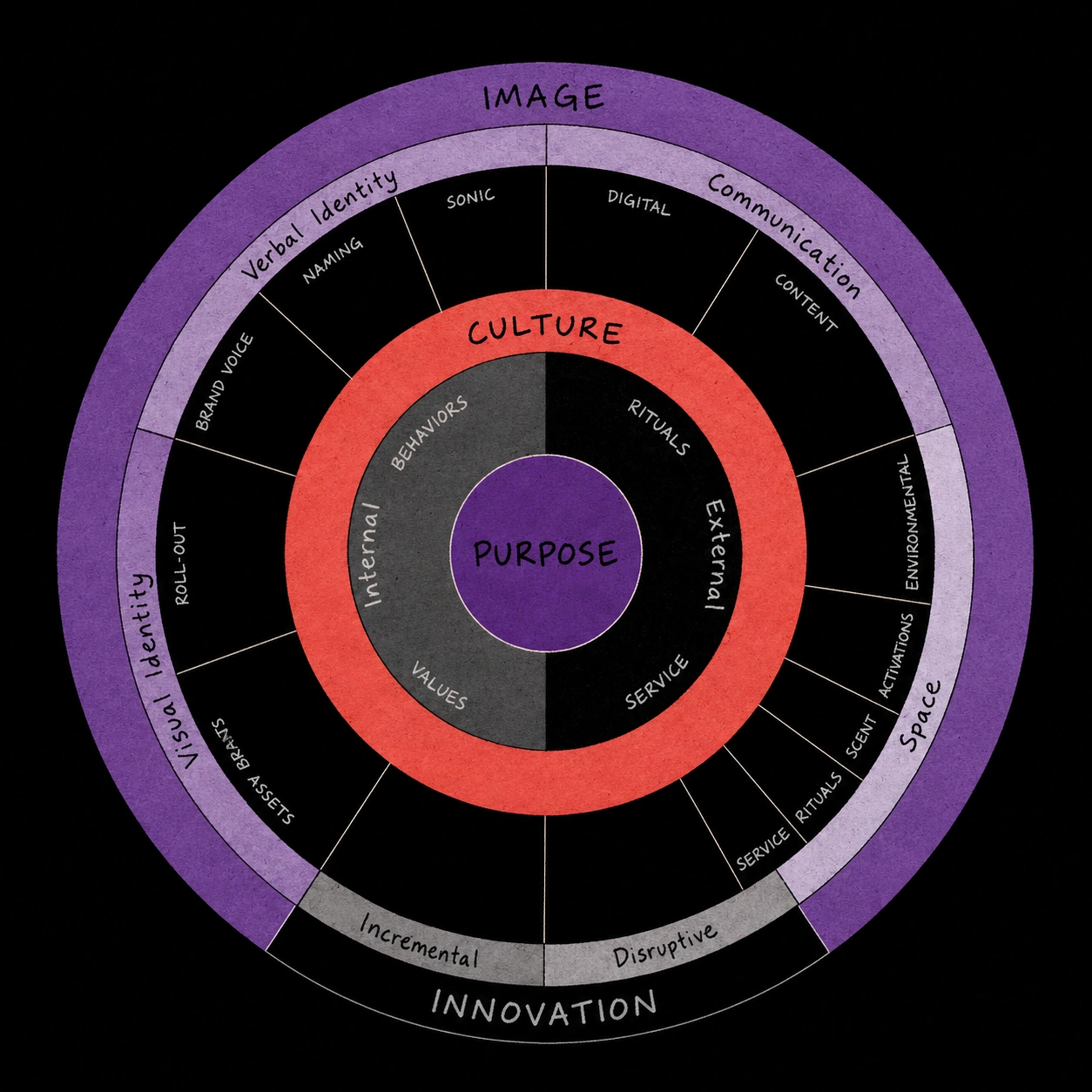
At Brand Lounge, we call this Maximize, the phase where Creative Impact takes full shape and the brand stops being a set of guidelines and starts being a lived experience.
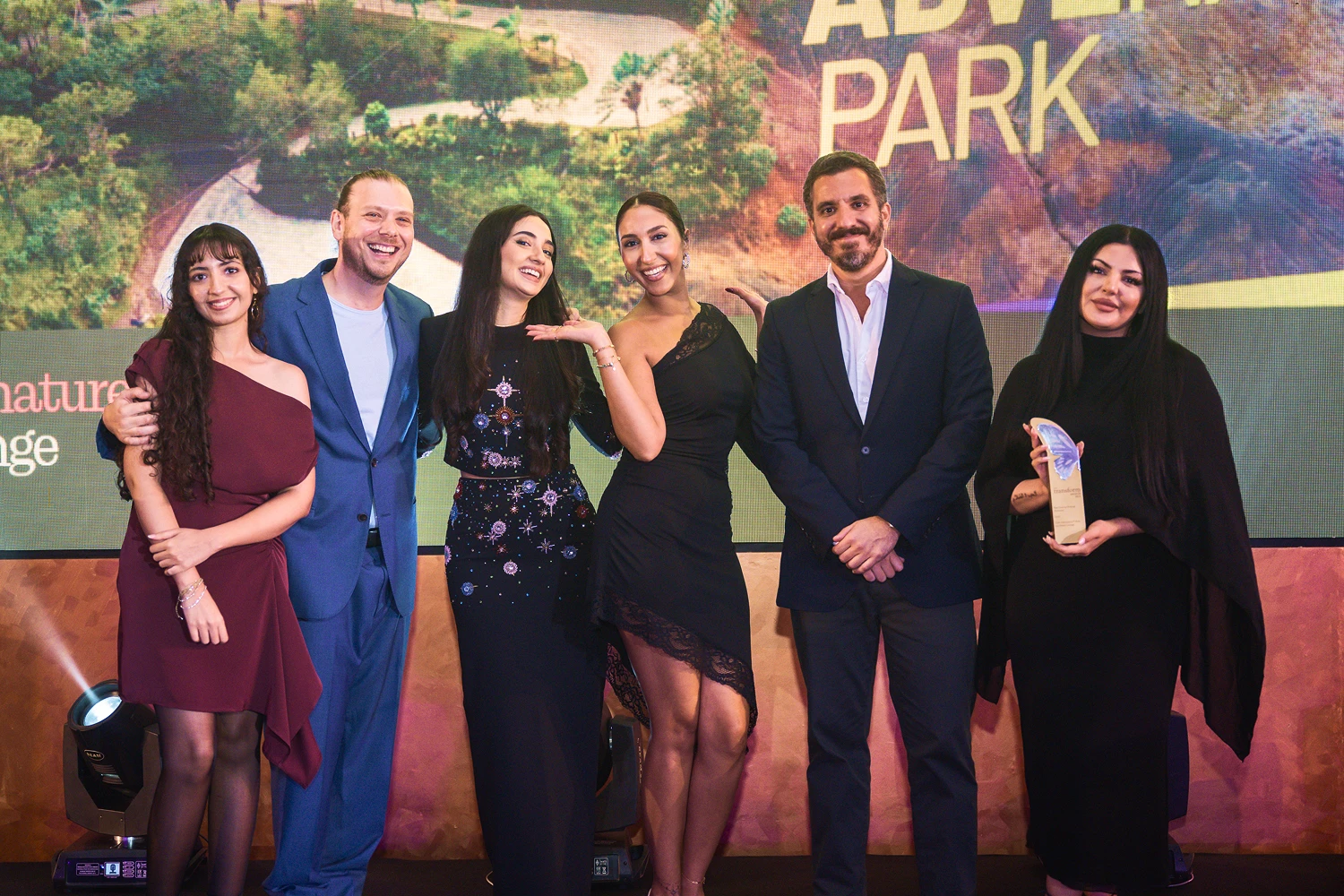
Our work with Makarem, the Saudi hospitality brand operating in Makkah and Madinah, is a clear example of what this looks like in practice. After repositioning Makarem as the pioneer of an entirely new category, Spiritual Hospitality, the heaviest and most meaningful work happened in the Maximize phase. We developed the full service culture around Makarem's 5 Virtues, created a dedicated photography and film library shot across Makkah and Madinah, built the digital presence, designed the wayfinding and spatial systems, and embedded the new brand purpose into employee onboarding across more than eight properties. The brand launched at the Umrah & Ziyara Forum in Jeddah and went on to receive coverage in Forbes Middle East. None of that impact would have been possible if the brief had stopped at guidelines.
Explore the Full Makarem Case Study.
When you write your RFP, ask prospective partners how they think about this phase. Ask what they recommend for launch. Ask how they approach the internal audience. The answers will tell you whether you're talking to someone who builds brands that matter or someone who delivers documents.
09 /
Should You Ask Agencies to Pitch Creative Ideas for Free?
No. And most serious agencies and consultancies will either push back or decline an RFP that asks them to.
A free creative pitch, where agencies are expected to develop strategic thinking and visual concepts with no compensation based on a brief they've just received, is a significant ask of any team's time and expertise. It also produces work that is, by definition, built without the depth of discovery that a proper branding process requires. You're not evaluating the quality of the work. You're evaluating how quickly a team can produce something that looks convincing under pressure. Those are not the same thing, which is why speculative creative work is widely discouraged across the design industry. (AIGA)
The better approach is to evaluate partners on the evidence they've already produced. Look at their portfolio critically. Not just whether the work looks good, but whether it demonstrates strategic depth, whether the thinking behind the visual decisions is visible and coherent. Look at how they talk about their work, in case studies, in conversations, in the way they respond to your brief with genuine insight rather than generic enthusiasm. Consider their visibility and recognition in the industry. Awards and editorial recognition are imperfect signals, but they are signals.
One criteria that genuinely doesn't need to be on your list is direct industry experience. It's a reasonable instinct. You want someone who understands your sector, your audience, your competitive dynamics. But branding is a strategic and methodological discipline, and a consultancy with a strong process will do rigorous discovery regardless of whether they've worked in your category before. In some cases, the absence of industry familiarity is an advantage. They come without assumptions. They ask the questions that someone too close to the category stopped asking years ago. If the methodology is sound and the strategic thinking is sharp, the industry context is learnable. It is not a prerequisite. Don't disqualify strong partners on this basis, and don't make it a formal evaluation criterion. You may be filtering out exactly the thinking you need.
When you meet with prospective partners, pay attention to the chemistry. Do they ask good questions? Do they challenge your assumptions in a way that feels useful? Do they have a clear point of view on how they would approach your specific challenge? That conversation, the quality of the thinking in the room, is a far more reliable indicator of what working together will be like than a speculative logo presented under deadline pressure.
It's entirely reasonable to ask agencies to respond to a brief with their strategic perspective, a proposed approach, and relevant experience. It is not reasonable to ask them to do the work before you've hired them. The organizations that understand this distinction attract better partners and start the relationship on the right terms.
10 /
What a Strong RFP Actually Contains
With all of the above as context, here is what a well-constructed branding RFP looks like in practice.
Company Background and the Strategic Challenge.
Not a marketing summary, but an honest account of where the brand stands today, what has changed, and why this moment is the right time. Name the gap you're trying to close as clearly as you can.
Audience.
Who are you trying to reach, and what do you want them to think, feel, and do differently as a result of encountering your brand? Be specific. A demographic range is not an audience definition.
Competitive Context.
Who are you competing with, and how does your category look and sound today? Where do you currently sit in relation to those competitors, and where do you want to sit?
Decision-Making Structure.
Who is the primary contact, who has strategic sign-off, who has creative sign-off, and how will conflicting views be resolved? Name the governance structure before the work begins.
Scope and Deliverables.
From strategy through identity, guidelines, and activation. Be clear about what is in scope for this engagement and what might follow in a subsequent phase.
Timeline.
A realistic one that reflects the complexity of the work. Include key milestones and decision points, not just a final delivery date.
Budget Range.
Include it. It enables proper scoping and attracts partners whose capabilities match your investment.
Confidentiality.
If the brief contains sensitive strategic or commercial information, consider whether you want prospective partners to sign an NDA before receiving the full document. Most serious consultancies will expect this for substantial exercises.
Credentials and Shortlisting Process.
Tell prospective partners how the evaluation will work. Will you review credentials first and shortlist before sharing the full brief? Or are you going straight to brief? Be thoughtful about your criteria. Prior industry experience is not a reliable proxy for quality of thinking. Evaluate on methodology, strategic depth, the caliber of the work, and the quality of the conversation when you meet.
What You're Looking for in a Response.
Strategic thinking, a proposed approach, relevant experience, and a clear point of view on how the partner would tackle your specific challenge. Not free creative work.
The brief you write before anyone is in the room already says something about your organization. It reflects how clearly you've thought about the challenge, how seriously you're taking the investment, and whether the conditions exist for genuinely good work to be made. The right partner will read it and know immediately whether this is a conversation worth having. Write it to attract the one you actually want.

Brand Lounge is an independent, award-winning strategic brand consultancy based in the GCC. We work with organizations across the region and beyond to build brands that matter, through strategy, design, culture, and innovation. Our work spans hospitality, real estate, government, retail, and financial services, and our process is built around one belief: that a brand is only as strong as the thinking behind it.
If you're preparing a branding RFP and would like to talk through the exercise before you brief, we'd welcome the conversation. Get in touch.
Latest News & Insights

.webp)

.webp)
.png)

.webp)
Our Practices
Through strategy, design, culture, and innovation, our practices are built to create brands with meaning.